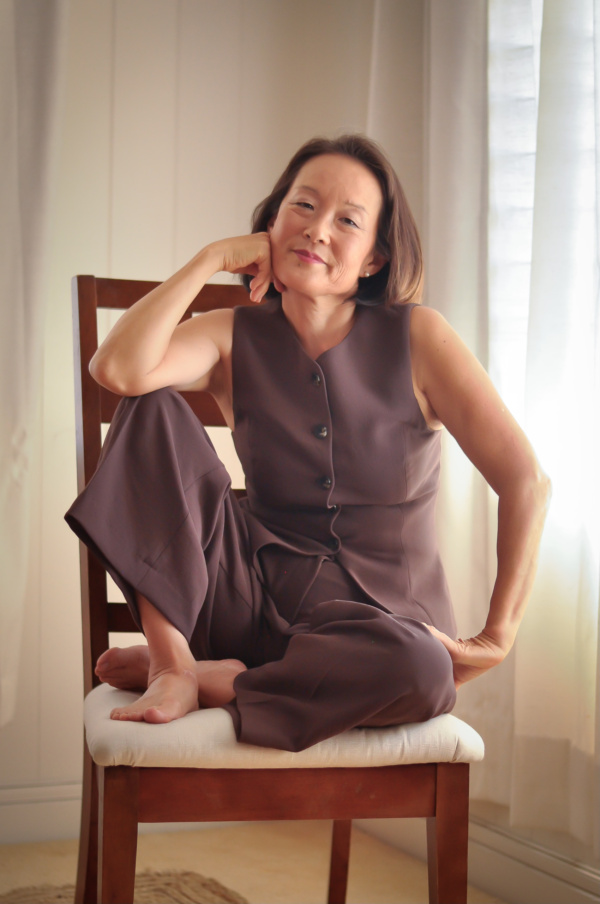
Dr. Stephanie Han is an award-winning author, founder of drstephaniehan.com, an online learning platform for writing and transformation, editor of the woman. warrior. writer. Substack that features women authors of color, and creator of the Divorce Story Structure a powerful tool to help women write their divorce stories for their legal and personal files as seen in Oprah Daily.
Her writing on narrative and divorce stories has been in in Honolulu Magazine, Andover Magazine, Embodied (NPR), The HI Review of Books (Nominee and Noted for Best American Essays, 2023), HONOLULU NOIR (Akashic)-Publishers Weekly called it “a standout”, and more. She is a contributing editor for The Hawaiʻi Review of Books.
Swimming in Hong Kong (Willow Springs Eastern WA Univ.) won the Paterson Fiction Prize, Spokane Prize, and was the sole finalist for AWP’s Grace Paley Prize. The collection was shortlisted for the Asian Books Blog Award, and stories won awards from The South China Morning Post, Nimrod International Journal, and Santa Fe Writer’s Project. Han is a former PEN and VONA fellow, and was the inaugural English Literature PhD of City University of Hong Kong. She writes, teaches, and surfs on Oahu, home of her family since 1904.
Contact:
writer@drstephaniehan.com
I was born in St. Louis, MO. My mother, Marie Ann (Han) Yoo, is a third-generation Korean American from Hawai’i, and my father, Dr. Tai-June Yoo is from Seoul, Korea. My maternal clan has been on Oahu since 1904; I’m a descendant from the very first wave of Koreans to leave their home country.
Yes, Han—my pen name, is my mother’s birth name! I love my mom:). I was a big baby. Mom said I was simply huge; I’m 5’1”. It’s amusing to know that at one point in my life I was considered terrifyingly big.
Dad got drafted after getting his U.S. green card and this, combined with his medical training and his research career meant that we lived everywhere from Seoul, Korea to Memphis, Tennessee. I have two sisters: Christine, born in Buffalo, NY and Katherine, born in San Francisco, CA.
I spent the bulk of my elementary school years in Iowa, although we made trips to Hawai’i to visit the ‘ohana, and entered Phillips Academy Andover at age 13. There I studied with great English literature teachers, made collages, had a messy room and mad crushes, did terribly in math, took many art and music classes, and wanted a life of art. Since I didn’t learn of or know any Asian American artists or writers, I didn’t know it was possible.
I went on to Barnard College–the last class before Columbia admitted women, and was lost and depressed. I believe much of this was down to recovering from boarding school, and what can be a very narrow world within elite institutions that are competitive, white, and patriarchal. I left university after two years. When I returned to finish my degree at University of California Santa Barbara, I was in my late 20s, living in Los Angeles, studying acting and writing poetry. I won a grant from the Los Angeles Department of Cultural Affairs to author a poetry chapbook, L.A. (Lovers Anonymous).
After graduation, I headed to Korea. A world opened up. Much of the frustration or discontent I experienced in the continental U.S. due to race did not exist in the same way for me in Asia. While there are always points of frustration anywhere you go, they were different, and I needed to experience this difference. Life unfolded: I married, had a child, taught, wrote, published, and found myself moving back and forth between the US and Hong Kong. I studied writing and literature at San Francisco State University (MA), labored as a journalist and communications writer, provided content for Netnoir–the first African American online company, won a PEN Emerging Voices Fellowship and scholarship to VONA, completed my MFA at the University of Arizona, taught K-12 and university, and settled into life in the rural village of Mui Wo, Lantau outside of Hong Kong. I witnessed the Umbrella Revolution, became the first Ph.D. in English literature awarded by City University of Hong Kong, moved back to Hawai’i, and finally published my fiction collection: Swimming in Hong Kong
The stories and the manuscript itself were rejected hundreds of times. The practice of writing is not always connected with the realities of publishing. The exact same stories that went on to win awards and prizes were the ones that many had passed on. I received a rejection for my short story collection three years after it was published! No writer will tell you that only great work gets published or conversely, that only poorly crafted work is rewarded.
The several years prior to COVID were tumultuous. I divorced and began life as a single parent. Divorce compelled a close examination of the influence of narrative. Why did I believe what I believed? The stories that govern our lives are based on texts written by men and are enforced by both men and women. How do patriarchal narratives affect our personal story? How do we obtain true empowerment in a society that does not see women as complete human beings? I started surfing and studying hula; I went back to work as a journalist and communications strategist; I taught secondary and university; I deeply questioned my purpose. How does one live authentically and kindly? What is the nature of belief and belonging? What is it to write and to live one’s truth to power? Given that we are more than 123 years from gender equity in the U.S., how does one function as a woman? How can women manifest the lives they want to live?
During COVID I launched my online teaching platform to answer my own questions, to share what I know, and to teach what I wish I had learned during my years of formal study. This time of global upheaval was one of reckoning, alignment, flow, and rebirth. The countless deaths reminded us that we must live authentically and compassionately. The cataclysmic shift I had personally experienced collided with global events and compelled me to reframe time, mission, and opportunity. I now work backwards from death: I write and teach what I believe to be the most important information that I can share with others. I began the woman. warrior. writer. newsletter to inspire women readers and writers, to literally or metaphorically author their lives. I wrote break: HOW TO WRITE YOUR DIVORCE STORY to provide women a framework to easily write their divorce stories for their legal/personal file and to transform their lives.
Time on this planet is short. We are here to love. We are here as stewards of our earth. That’s it.
Any student will tell you that I will be honest with you and help you to improve your craft. The more stories that women write, the better we are as a society. We live under words written by men. True change requires women to commit words on the page. We cannot interpret and uphold stories. We must write them.
Growing up, I was unable to see what I wanted to be in books or anywhere in popular media. I came to writing to write myself into being. I did not see myself as existing because there was nothing to reflect who I was or any of the experiences that I had. The very nature of art and creativity is rebellion. I wrote because I had a desperate need to be seen and to believe that I existed.
To create, one must be.
Our lives are stories, and our greatest purpose is to author our lives. (Think in metaphor!) Understanding narrative and writing with the knowledge of storytelling principles leads to empowerment. Everything you live by, believe, fear, embrace is rooted in text and story.
We create the story of our lives.